
Atmospheric Chemistry and Physics ACP Award 2025
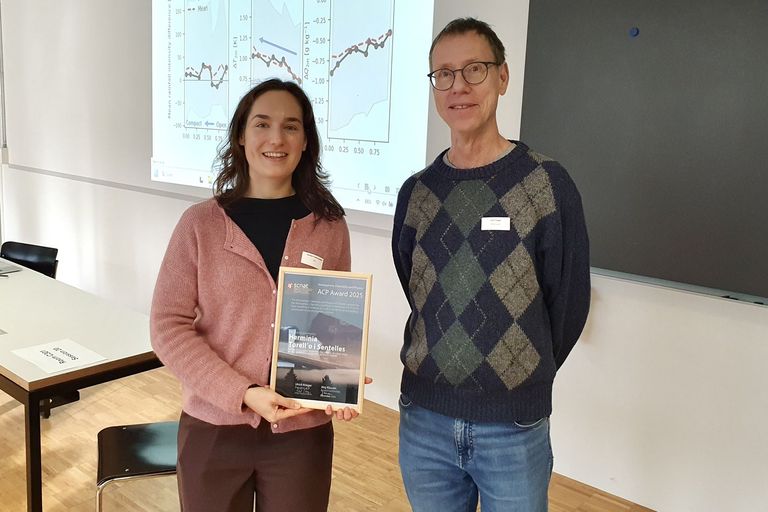
At the 23rd Swiss Geoscience Meeting, held in Bern in December 2025, the Atmospheric Chemistry and Physics Award was presented to Hermenia Torell'o i Sentelles for her doctoral thesis “Exploring the effects of urban areas on the space time properties of heavy rainfall.” Her research investigates how cities of varying sizes and climatic settings modify precipitation patterns. Using remote-sensing data, particularly weather radar observa-tions, she analysed storm behaviour in space and time with a storm tracking algorithm. Building on these findings, she applied convection resolving numerical modelling to uncover the dynamic and thermodynamic mechanisms that drive the urban influence on extreme precipitation.
Image: ACP
Atmospheric Chemistry and Physics ACP Award 2024
At the Swiss Geoscience meeting in Basel in November 2024, the ACP Award for Atmospheric Research was presented to Dominique Rust for her PhD thesis “Verification of halogenated greenhouse gas emissions by regional atmospheric observations in Europe”. Her work covers a wide range of methods, from precision measurements of gases to statistical data analysis. The award committee was particularly impressed by one part of her thesis work: In a tracer-release experiment she could quantify emissions from a fluorocarbon industry cluster and could show that effective abatement measures do reduce HFC emissions.
Image: ACP