
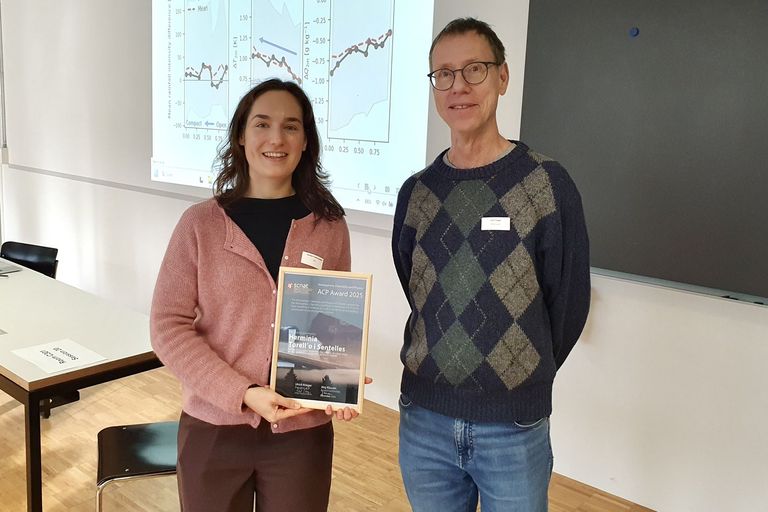
Atmospheric Chemistry and Physics ACP Award 2025
At the 23rd Swiss Geoscience Meeting, held in Bern in December 2025, the Atmospheric Chemistry and Physics Award was presented to Hermenia Torell'o i Sentelles for her doctoral thesis “Exploring the effects of urban areas on the space time properties of heavy rainfall.” Her research investigates how cities of varying sizes and climatic settings modify precipitation patterns. Using remote-sensing data, particularly weather radar observa-tions, she analysed storm behaviour in space and time with a storm tracking algorithm. Building on these findings, she applied convection resolving numerical modelling to uncover the dynamic and thermodynamic mechanisms that drive the urban influence on extreme precipitation.
Image : ACP
Atmospheric Chemistry and Physics ACP Award 2024
At the Swiss Geoscience meeting in Basel in November 2024, the ACP Award for Atmospheric Research was presented to Dominique Rust for her PhD thesis “Verification of halogenated greenhouse gas emissions by regional atmospheric observations in Europe”. Her work covers a wide range of methods, from precision measurements of gases to statistical data analysis. The award committee was particularly impressed by one part of her thesis work: In a tracer-release experiment she could quantify emissions from a fluorocarbon industry cluster and could show that effective abatement measures do reduce HFC emissions.
Image : ACP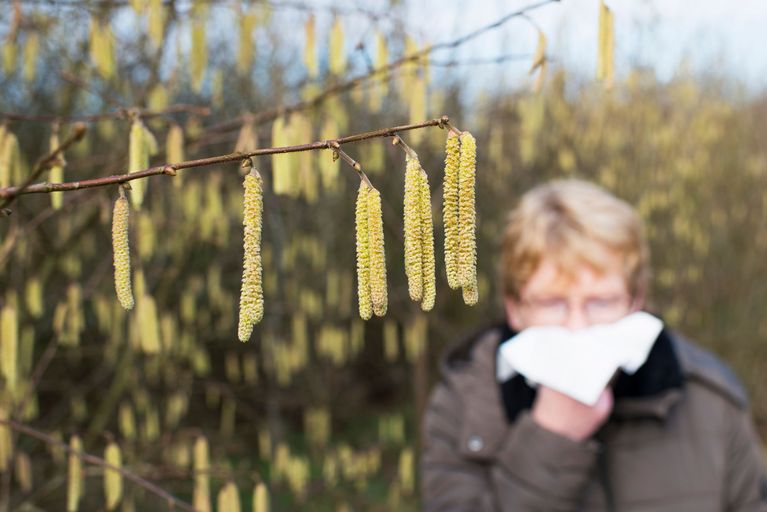
Le rhume des foins augmente en raison du changement climatique
Avec le changement climatique, la période du rhume des foins s'allonge, les concentrations de pollen augmentent et les plantes invasives hautement allergisantes se propagent. Des chercheurs de la Commission suisse pour la chimie et la physique de l'atmosphère (ACP) de l'Académie suisse des sciences naturelles et de MétéoSuisse ont évalué et résumé les connaissances actuelles à ce sujet.
Image : stock.adobe.com/schulzieAllergie au pollen et impact du changement climatique
Alors que le rhume des foins était pratiquement inconnu en Suisse il y a 100 ans, environ 20% de la population suisse souffre aujourd’hui d’une allergie au pollen. Le changement climatique a pour conséquence un début plus précoce et une intensité accrue de la saison pollinique de nombreuses plantes allergisantes. Il favorise aussi la pro- gression de plantes invasives très allergisantes telles que l’ambroisie. De plus, l’exposition combinée à la pollution atmosphérique et au pollen peut aggraver les réactions allergiques en raison d’une augmentation de la sensibilité des personnes et de l’allergénicité du pollen. Des scientifiques de la Commission chimie et physique de l’atmosphère expliquent comment le changement climatique influence à la fois le pollen et le rhume des foins.
Image : CC BY-NC-ND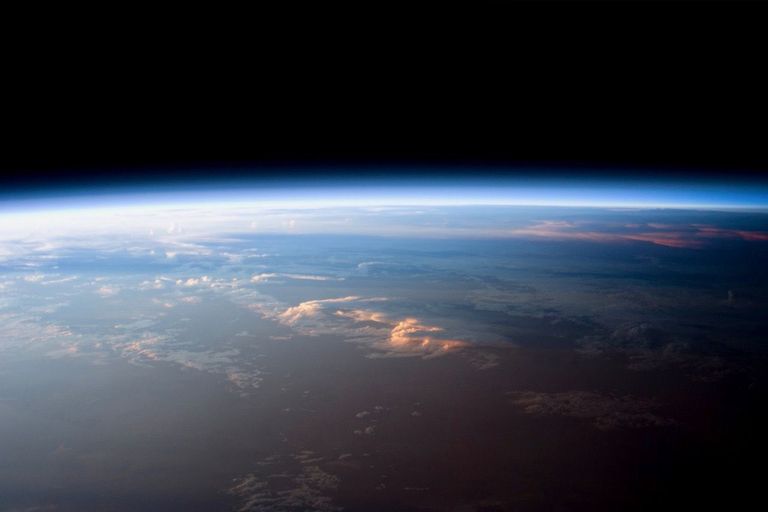
Atmospheric Chemistry and Physics ACP Award 2023
At the occasion of the Swiss Geoscience meeting in Mendrisio in November 2023, the ACP Award for Atmospheric Research was presented to Marina Friedel for her PhD thesis "The role of Arctic ozone in forcing Northern Hemispheric climate". Her work shows that the springtime Arctic ozone depletion causes surface anomalies across the Northern Hemisphere on both seasonal and multi-decadal timescales. Her results were recognised in the summary report of the 2022 WMO/UNEP Ozone Assessment.
Image : NASAAtmospheric Chemistry and Physics ACP Award 2022
At the occasion of the Swiss Geoscience meeting in Lausanne in November 2022, the ACP Award for Atmospheric Research was presented to Lea Beusch for her PhD thesis ‘MESMER – A Modular Earth System Model Emulator with Spatially Resolved Output’. In her thesis, she developed a regional Earth System Model (ESM) emulator, which is able to emulate the output of geographically-resolved ESMs, based on a given global temperature input. Lea Beusch demonstrated how MESMER can be used to recombine global and regional features of ESMs to cover a larger phase space with the emulator, potentially including observational constraints.
Image : NASA